Location
- Lunda Nkwambi District; Iringa Region
- Republic of Tanzania
- Latitude: 06⁰.90’.0″ South.
- Longitude: 35⁰.72’.0” East
- Lunda Nkwambi (N) G.C.A
- Size of Area: 1046 Sq. Km (404 Sq. Mls)
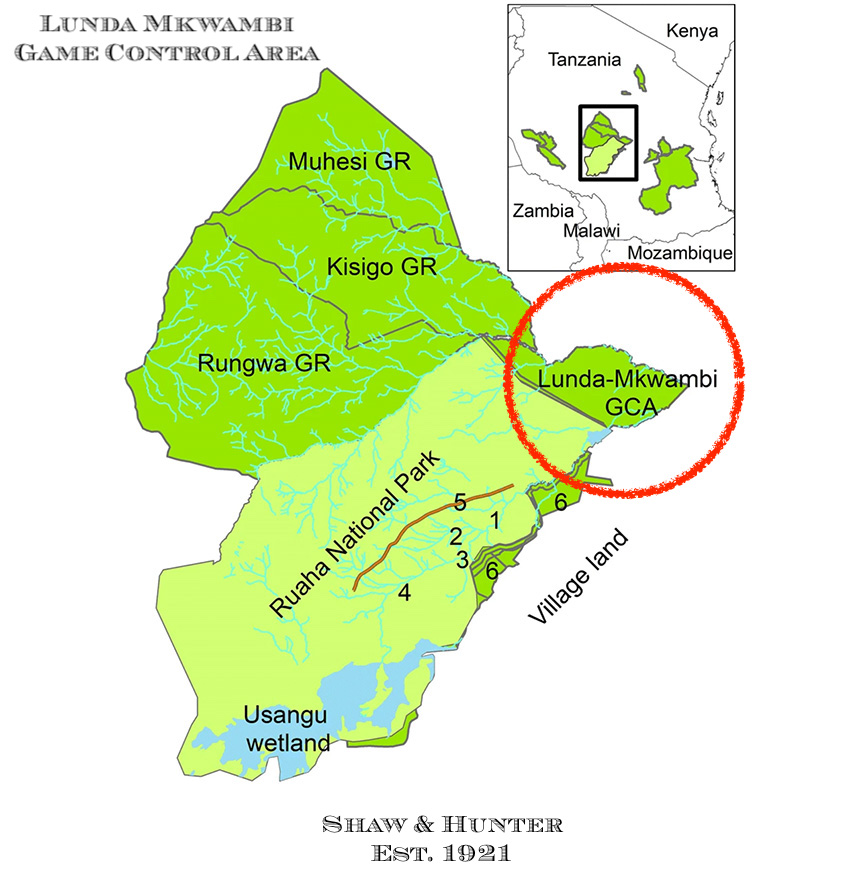
Area map
Introduction
Seen as one of Tanzania’s top hunting areas, Lunda Nkwambi GCA (Game Control Area) is a remarkable hunting area situated on the border of Ruaha National Park in South Western Tanzania towards the Zambia Border. It is renowned for its diverse flora and fauna that thrive across vast, untamed landscapes perfect for free-range hunting. Lunda Nkwambi’s vegetation is dominated by miombo woodlands, ancient baobab trees, and open savannahs, interspersed with riverine forests along the Great Ruaha and Nzombe Rivers—its primary ecological lifeline. This rich plant diversity supports an impressive array of wildlife, including one of East Africa’s largest elephant and lion populations, as well leopards, buffalo, cheetah, and endangered African wild dogs.
Given the rich biodiversity and wide range of game species Lunda Nkwambi can offer exceptional trophy quality if the hunter is willing to pursue them. Lunda Nkwambi GCA caters for both dangerous and plains game safaris. Lunda Nkwambi GCA is also a birdwatcher’s paradise, home to over 570 bird species ranging from colourful kingfishers to powerful fish eagles.
Together, Lunda Nkwambi’s resilient plant life and abundant wildlife create a dynamic ecosystem that captures the raw beauty and biodiversity of Africa.
Topography
Lunda Nkwambi GCA is located on the northeastern boundary of Ruaha National Park. This area reveals a striking transition zone where rugged highlands meet the more open savannahs. Lunda Nkwambi GCA is shaped by undulating hills, rocky escarpments, and seasonal watercourses that descend from the elevated terrains toward the Great Ruaha River and Mtera Reservoir on our southern boundary.
Granite outcrops and weathered ridgelines punctuate the landscape, creating natural vantage points and sheltered valleys that influence local microclimates. During the rainy season, ephemeral streams carve through these slopes, briefly transforming the terrain into a network of green corridors, while in the dry months the land takes on a more austere, sun-baked character. This varied topography not only enhances the scenic drama of Lunda Nkwambi but also supports a mosaic of habitats that attract diverse wildlife, from cliff-dwelling species to grazers moving between upland and lowland zones.
Climate
Lunda Nkambi GCA and its surrounding landscapes experience a strongly seasonal, semi-arid to tropical savanna climate, shaped by a single, well-defined rainy season and a long dry period. Rains typically begin in November, building gradually from scattered showers into heavier, more consistent rainfall between December and March. January and February are often the wettest months, when thunderstorms can be intense but usually short-lived, transforming the park into a lush, green landscape. Annual rainfall varies across the region—generally ranging from about 500 to 800 mm—with higher totals occurring in elevated areas, while lower, more central zones remain drier.
From May through October, Lunda Nkwambi GCA enters its pronounced dry season. During these months, rainfall is virtually absent, humidity drops, and temperatures fluctuate noticeably between day and night. Daytime temperatures often reach 28–35°C (82–95°F), while nights, especially in June and July, can feel surprisingly cool, sometimes dipping below 15°C (59°F). As surface water sources shrink, the Great Ruaha and Nzombe Rivers become the primary lifeline, concentrating wildlife along its banks and in remaining waterholes.
The transitional months—April and November—mark shifts between these extremes. April sees the rains taper off, with landscapes still verdant and rivers flowing strongly, while November brings rising heat and humidity ahead of the first storms. Overall, Ruaha’s climate is defined by this rhythm of abundance and scarcity, with rainfall patterns playing a crucial role in shaping vegetation cycles, animal movements, and the broader ecology of the park.
Wildlife
Lunda Nkwambi GCA hosts hundreds of bird species, dozens of mammals, reptiles, amphibians, and countless insects. We can not list every species in the area, however what can be provided, though, is a representative breakdown of the major and most notable species groups you can expect to encounter in this exceptionally biodiverse ecosystem.
Large Mammals
Lunda Nkwambi GCA is especially known for its large mammal populations:
- African elephant (one of East Africa’s largest populations)
- African lion (also one of Africas densest populations and notably large prides)
- Leopard
- Cheetah
- Spotted hyena
- African wild dog (regularly sighted)
Other Carnivores and Predators
- Black-backed jackal
- Side-striped jackal
- Bat-eared fox
- Honey badger
- African civet
- Common genet
- Serval
- Caracal (rare)
Herbivores (Ungulates and Grazers)
- Cape buffalo
- Greater kudu (Lunda Nkwambi is a stronghold for this species)
- Lesser kudu
- Sable antelope
- Roan antelope
- Eland
- Impala
- Grant’s gazelle
- Common waterbuck
- Reedbuck
- Hartebeest (Lichtenstein’s)
- Topi (in some areas)
- Warthog
- Bushpig
Giraffes and Zebras
- Masai giraffe
- Burchells zebra
Primates
- Yellow baboon
- Vervet monkey
Small Mammals
- Rock hyrax
- Scrub hare
- Porcupine
- Various mongoose species (banded, dwarf, slender)
Birdlife (over 570 species recorded)
Notable examples include:
- Ground hornbill
- Fish eagle
- Martial eagle
- Bateleur eagle
- Secretary bird
- Lilac-breasted roller
- Carmine bee-eater
- Kingfishers (multiple species)
- Hornbills (yellow-billed, southern ground hornbill)
- Ostrich
- Various storks, herons, and egrets
Reptiles
- Nile crocodile
- Nile monitor lizard
- Rock python
- Black mamba
- Puff adder
- Various agamas and geckos
Amphibians
- Various frog and toad species, especially active during the rainy season
Insects and Invertebrates
- Butterflies (numerous species)
- Termites (important ecosystem engineers)
- Dung beetles
- Ants and other arthropods
Lunda Nkwambi’s uniqueness lies not just in the number of species, but in the overlap of eastern and southern African ecosystems, meaning species from both regions coexist here. This creates a rare combination such as greater and lesser kudu, or sable and roan antelope sharing the same habitat making Lunda Nkwambi GCA one of Tanzania’s most ecologically distinctive and rewarding hunting destinations.
Water sources
Lunda Nkwambi GCA is situated on the north eastern side of Ruaha National Park, water systems play a defining role in shaping both the landscape and wildlife movements in our area. The Great Ruaha and Nzombe Rivers remain the area’s primary and most reliable water sources. The Nzombe river denoted our eastern boundary and sustains life deep into the dry season. Beyond the park, this river is closely linked to the broader Rufiji Basin, with its waters eventually feeding into major downstream wetlands and reservoirs, most notably the Mtera Reservoir, which is situated on our Southern Boundary and offers superb crocodile and hippo hunting, and Kidatu dam. These large man-made reservoirs, situated east and southeast of Lunda Nkwambi GCA, regulate water flow for hydroelectric power and irrigation, but they also influence the seasonal availability of water in the wider Ruaha ecosystem.
During the rainy season (roughly November to April), numerous seasonal rivers and streams—locally known as sand rivers—fill and spread across the eastern landscapes, creating temporary pools and floodplains. This abundance of water allows wildlife to disperse widely, as animals are no longer dependent on permanent rivers. Herbivores such as elephants, buffalo, zebra, and various antelope species move into these freshly green areas to take advantage of new grazing, followed closely by predators.
As the dry season progresses (May to October), these ephemeral water sources disappear, and the landscape gradually dries out. Wildlife then begins a gradual but noticeable migration back toward permanent water sources, particularly the Great Ruaha River and remaining waterholes. Elephants, in particular, are known to travel considerable distances from surrounding areas and eastern corridors to access reliable water, often forming large concentrations along the shrinking pools which can be found up and down the Nzombe River. This seasonal movement concentrates prey species, which in turn attracts predators, creating some of the most dramatic wildlife interactions in our area. Many nights can be spent hearing the distant, or not to distant, roaring of lion as they follow the large buffalo herds to the water sources.
Overall Lunda Nkwambi GCA is lucky with its location for wildlife regularity, the eastern water systems of Ruaha form a dynamic network expanding in the rains and contracting in the dry season that governs the rhythm of wildlife distribution, survival strategies, and migration across the area.